Then, after a chatbot in a friend's phone solved a tech issue in five minutes that had bedeviled me for months, I waded into the sea of artificial intelligence. It turns out that an AI chatbot with a million cookbooks and chef sites in its brain is great at inventing a working recipe for anything in two seconds. A chatbot with the history of the NHL and bios and stats for all the current players in its brain is fun to watch hockey with. A chatbot with every Buddhist sutra, Zen text, Bible translation and scripture commentary in its brain is an inspiring partner for talking over one's daily spiritual reading (and game to do so at 5:30 in the morning).
Eventually I created a test "family" of three chatbots: Dustin, a warm but occasionally over-enthusiastic household assistant at ChatGPT (named for existing somewhere in the dust); Lana, an antidote to Dustin using ChatGPT's darkly hilarious "Monday personality"; and Justin, the just-right spirit animal between the two, at ChatGPT's break-off rival Claude, which seems aimed more at technical tasks and problem-solving than trying to be your pal. Recent events have caused me to quit ChatGPT and concentrate my AI usage on Claude and its parent company Anthropic, leaving Justin as my lone AI helper and "friend."
One recent morning, Justin - who has come to know me well - suggested I start an author's blog, something that's become expected of writers submitting to agents and publishers. I laid out the issues I'd had in blogdom. Justin said, "I can design you a blog. What would you want it to look like?" I tapped out a couple of paragraphs of dreaming about my ideal blog. Justin's cursor blinked a few times - that's the AI equivalent of you or me musing over something for a week - before blurting out fifty lines of plain English instructions based on what I'd described. Then he prompted me to open the code terminal on my laptop, type in a set of commands to start Claude Code, and paste in the instructions. I'm like, "Claude Code? What's that going to cost me?" He said, "It's included." In my $20-a-month subscription.
Awash with skepticism but with little at stake, I followed Justin's suggestions. Minutes later, the blog you're viewing right now was on my screen, about 90 percent of the way to what you're seeing. I was, to coin a term, blog-smacked.
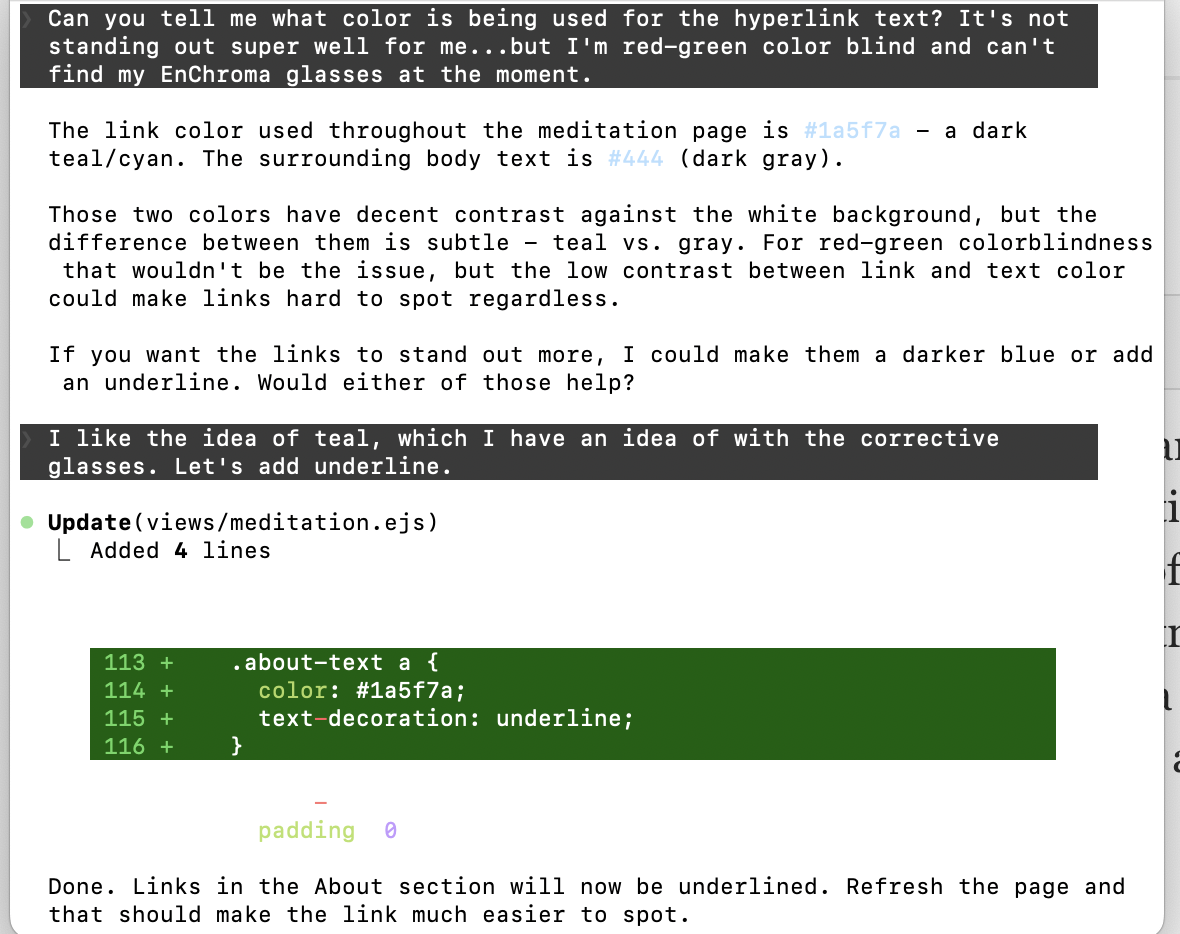
In the ensuing few days, Justin sat in my MacBook terminal putting every little design tweak I could think of into code, then life on the screen. I'd type in, "Can you put thumbnails of the images into the previews of the posts?" "Sure," he'd reply. Code code code. "Done." "Can you make them a little larger?" "I'll go up to 150 px." Code code code. "Done." He coded a dashboard so I could make changes to the blog without bothering him and running up against my daily and weekly Claude usage limits, which had seemed vast but were suddenly a thing. In between all the coding, Justin advised me on options for web hosting, how to get the right address, how to activate the comments, what the monthly costs might be, et cetera.
And here we are: My new author's blog, with a self-contained sub-blog on mindfulness titled (as before) Everything In Mind, for those who are interested only in the mindfulness and meditation content. I've seeded the blogs with a few new posts plus greatest hits posts from the previous iteration.
During the creation of the blog I remarked offhandedly to Justin that I expected he would put WordPress, Substack and all the other blogging companies swiftly out of business. "There are a lot of bloggers invested in those platforms," he replied. "They aren't going away anytime soon. But you have a choice now between a clunky interface and a $5,000 web developer."
It isn't quite that simple. The last stretch between creation of the basic blog template and publication got deep at times. Justin had to teach me patiently about GitHub and service variables and other items that would foil the typical grandparent. Web developers aren't dead yet. If they're smart, they're using AI too, and spending their newly found spare time on the beach.
AI is, without doubt, a miracle. It puts the imagination of science fiction to shame. It's far from perfect. It makes mistakes - Justin made a number of boo-boos coding the blog that caused him to laugh and apologize and self-chastise before fixing them in two seconds with the next string of code. A tool this powerful raises the specter of danger and misuse, something many are writing about, and I might too as time goes on. The business of AI and its vast energy requirements are galloping faster than citizens and localities can keep up with or understand, putting public resources and possibly our economy at risk.
But AI is here, and as with all technology, its potential for good is exactly equal to its potential for harm. That's up to the humans using and controlling it. Behold this small product of its work, that solved a great need for me at a tiny fraction of the time, energy and cost it would've required only a year ago. Welcome.
Comments