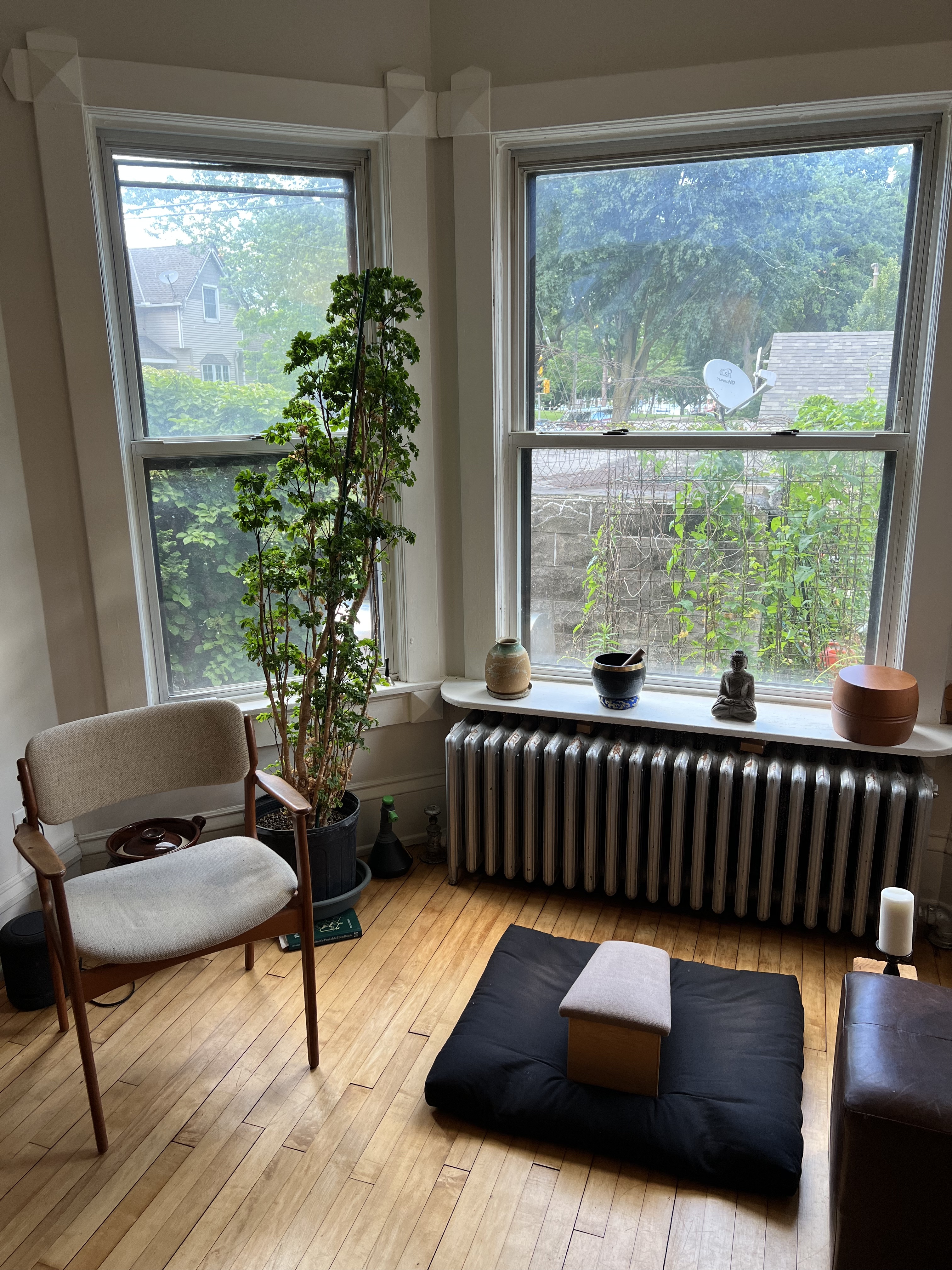
 For the first few years I practiced Zen, I meditated 12 minutes a day. Why 12 minutes? It took 12 minutes for my pot of morning coffee to perk, there wasn’t much else to do in those 12 minutes, and I had no appetite for sitting longer than that. I would turn restless, feeling I was needed elsewhere, that the day was moving on without me.
Later, when I grew out of solo practice and joined a Zen center, I found out 12 minutes is considered a short period by most meditators. More common is to sit 20 minutes, sometimes called “meditation standard time.” My first Zen teacher told me not to worry about it. He said I’d grown a strong practice in my shorter periods because they were steady. I never missed a day because I can’t start a day without coffee.
Sitting longer periods in a Zen center eventually prompted me to sit longer on my own. These days I sit 25 minutes at least once a day, matching the formal periods of my current sangha. It troubles me, though, as someone who’s become a teacher of meditative practice, how many beginners struggle to sit 5 or 10 minutes, much less 20 or 25, and give up meditation entirely because they feel they can’t meet some sort of minimum requirement. “It all makes sense,” they’ll say, during or outside class. “It just isn’t me.”
Here are some truths not spoken loudly or often enough in the Zen and mindfulness worlds:
- A single minute of meditation can be transformative.
- When it comes to meditation, how regularly is more important than how long.
- Sitting is a good way to meditate, but you don’t have to sit to meditate.
- Some dedicated practitioners of mindfulness and faithful Buddhists don’t sit at all.
My first Buddhist sangha, when I lived in Madison, Wisconsin, was in a Korean-lineage Zen school. Like other imported branches of Zen, it was founded by a celebrated Zen master who came to the US from Asia when young Americans in the Love Generation of the 1960s became hungry for new kinds of spirituality. However, this particular teacher, Seung Sahn, at first didn’t find it necessary to teach his students formal sitting meditation. It hadn’t been a point of emphasis in his Korean order.
Eventually he incorporated sitting meditation by popular demand of Americans who didn’t feel Zen enough unless they were looking more the part. But he continued to teach that more important than sitting is “action Zen,” the practice of doing everything in life mindfully, with sensory experience taking priority over self-referential thinking. When you drink tea, only drink tea. When you play tennis, only play tennis. When you drive, only drive. If you’re driving and thinking about something other than driving, you’ll miss the stop sign and have an accident!
And, when you’re thinking, only think.
These days, living in Milwaukee and Mexico and thanks in part to the miracle of Zoom, I’ve settled into practice at a Chicago Zen center in a Japanese lineage with a familiar, traditional approach to sitting meditation. But I sometimes recommend other ways of meditation with students in mindfulness classes there, especially if they’re having difficulty sitting still.
Walking meditation is great for those who don’t like being sedentary. Pick any route or pace. Walk as normal. But pay attention to the sensory experience of the walk instead of a thought world away from the walk. Often walking meditators will find their breath settles into a rhythm with their steps and forms a drumbeat for meditation, not unlike a mantra – I tend to settle into an in-breath of two steps and an out-breath of three, but everyone’s experience is unique. When mind wanders, let it go, and return attention to the act and feel and rhythm of the walk.
Are you a runner? That works too, same routine.
At any idle period of the day, even if only for a few seconds, mindful people can practice what I think of as micromeditation. Waiting in line at the grocery checkout, for example, we can breathe mindfully and feel the sensory experience of that and our surroundings, instead of letting mind spin impatiently. The impulse to check the smartphone can work as a cue to practice a few moments of meditation instead. For as often as I experience an urge to check my phone, I feel like I can get the equivalent of a full sitting period every day just in meditation on the fly.
As someone who has at times faced long commutes to work, I’ve found driving to be an excellent meditation opportunity. Meditation while driving sounds like a disaster, I know. But mindful driving – only driving, and letting mind be full of that experience rather than non-driving thoughts – is the safest kind of driving, and it brings the same sort of benefit as mindfulness anywhere else.
Bringing mindfulness to the act of athletic competition has a name among dedicated athletes: being in “the zone.” My first career was as a sportswriter, and I heard pro athletes talk of the zone as a state in which thoughts of how to play and fears of failure drop away, and the sport starts to virtually play itself, a state achievable through many hours of practice. Meditative practice is about helping to call the zone forth in all aspects of life.
All this isn’t to denigrate sitting meditation. Sitting stable in the correct posture is a way of meditating that’s been proved effective across centuries. But it’s not the only way, especially for those who are still building comfort in sitting, or for those who simply aren’t into sitting around.
Comments